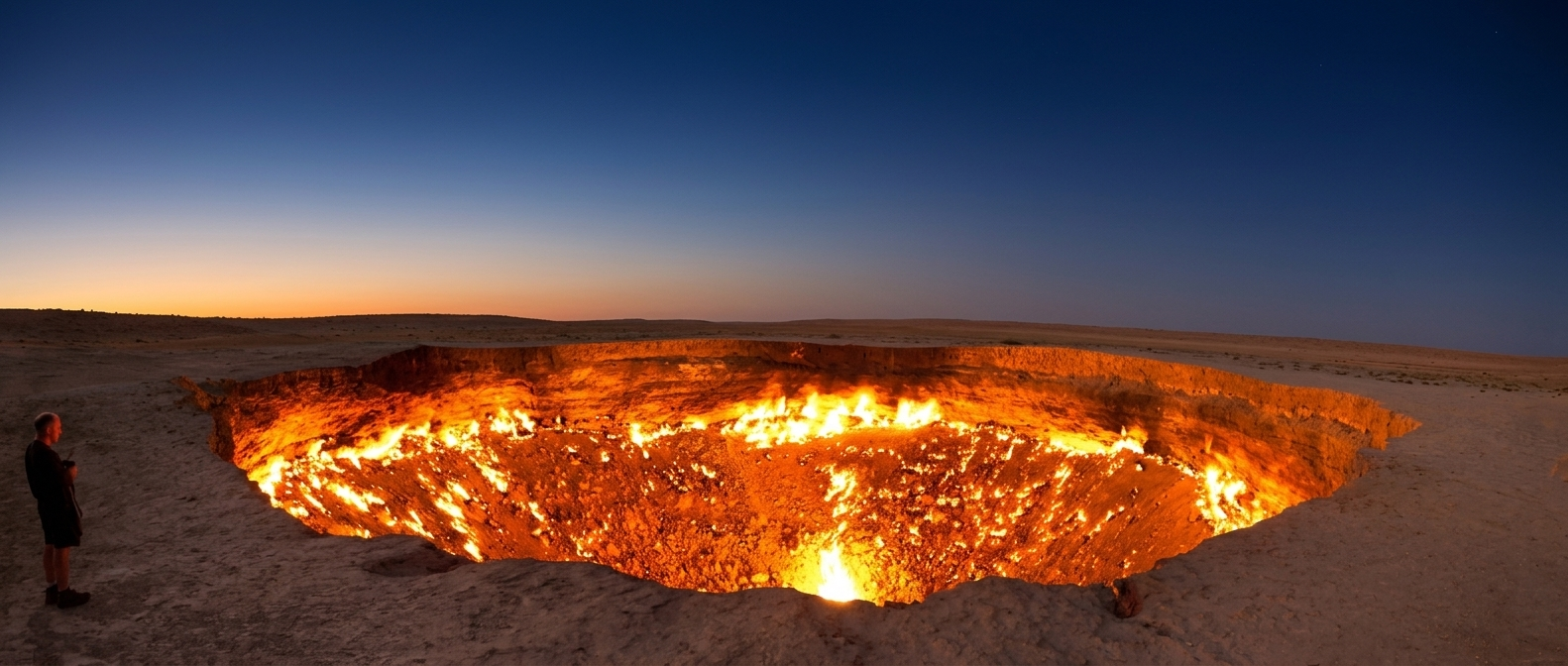
Deep in the vast Karakum Desert of Turkmenistan, far from major cities and surrounded by seemingly endless sand, stands one of the most unusual and mysterious sights in Central Asia: the Darvaza Gas Crater, internationally known as the “Gateway to Hell” or “Door to Hell.”
The site is a huge depression in the desert floor filled with natural-gas flames. For decades, the orange glow of the fire has illuminated the surrounding desert after sunset, creating an extraordinary landscape that looks almost otherworldly.
The crater is not an ancient volcanic feature or a naturally occurring inferno. Its modern history is connected to Soviet-era natural-gas exploration in the early 1970s, when drilling activity resulted in a ground collapse and the release of underground gas.
Today, Darvaza represents an unusual combination of geology, industrial history, environmental debate and adventure tourism.
Where Is the Gateway to Hell?
The Darvaza Gas Crater is located in the Karakum Desert, approximately 260–270 kilometers north of Ashgabat, the capital of Turkmenistan. It is associated with the Darvaza/Derweze area in central Turkmenistan.
The surrounding landscape is extremely remote. The Karakum is one of the defining geographical features of Turkmenistan, covering a large portion of the country’s territory. Its name comes from Turkic words generally translated as “Black Sand.”
For travelers, the remoteness is an important part of the experience. There are no urban surroundings, shopping streets or conventional tourist infrastructure around the crater. Instead, visitors encounter:
- Vast expanses of desert
- Sand dunes and dry plains
- Extremely dark night skies
- Sparse vegetation
- A large burning crater
- Traditional desert camps and yurts
- Other unusual gas and mud formations nearby
The isolation makes the contrast between the dark desert and the glowing crater particularly dramatic.
What Is the Darvaza Gas Crater?
The Darvaza Gas Crater is essentially a large collapsed area containing an underground natural-gas source.
The crater is generally described as approximately 60–70 meters across, although measurements vary between sources, while its depth has been reported at roughly 20–30 meters.
Natural gas escaping from below the surface feeds flames distributed across the crater.
During daylight, the site can appear surprisingly stark. The surrounding desert dominates the landscape, while the crater resembles a huge geological depression.
After sunset, however, its appearance changes completely.
Hundreds of individual flames can illuminate sections of the crater, producing an intense orange and yellow glow. The heat becomes noticeable as visitors approach the rim, and the fire can sometimes be seen from a considerable distance across the desert.
Why Is It Called the “Gateway to Hell”?
The name “Gateway to Hell” is a popular nickname rather than an official geological designation.
Other commonly used names include:
- Door to Hell
- Gates of Hell
- Darvaza Gas Crater
- Darvaza Crater
- Derweze Gas Crater
- Shining of Karakum
The dramatic nickname comes from the crater’s appearance: a giant hole in an otherwise empty desert with flames continuously burning inside it.
At night, the combination of darkness, fire, heat and the crater’s enormous dimensions naturally inspired the comparison to a portal into the underworld.
Turkmenistan’s own government publications have also described the site as having acquired the figurative name “Gates of Hell” among the public.
The Story Behind the Fire
The most widely reported history dates the formation of the crater to 1971, when Turkmenistan was part of the Soviet Union.
Soviet geologists were conducting exploration for natural gas in the Karakum Desert. During drilling operations, the ground reportedly collapsed into an underground cavity.
The collapse created a large depression and released natural gas into the atmosphere. Soviet engineers were concerned about the uncontrolled release of gas and the potential danger associated with it.
The gas was reportedly ignited with the expectation that the available fuel would eventually be consumed and the fire would extinguish itself.
That expectation proved dramatically wrong.
Instead of burning out within a short period, the fire continued for decades. NASA described the original Soviet expectation as a fire that would burn for only a few days; decades later, the crater was still producing flames.
How Reliable Is the 1971 Story?
The basic story of Soviet-era drilling, collapse, gas release and ignition is widely repeated, but some details of the crater’s origins remain disputed.
Recent scientific and journalistic accounts note that alternative versions exist concerning exactly when and how the crater formed. Some accounts suggest a formation date in the 1960s, while the commonly accepted narrative places the major drilling accident in 1971.
Turkmenistan’s official oil-and-gas publication gives the 1971 drilling-collapse explanation and describes the crater as approximately 60 meters in diameter and 20 meters deep.
Therefore, the safest description is that the Darvaza crater is associated with Soviet natural-gas exploration in the early 1970s, with 1971 being the date most commonly cited for its creation and ignition.
Why Has the Fire Continued for So Long?
The answer is underground natural gas.
Natural gas escaping from geological formations beneath the crater has continued to provide fuel for combustion. The fire does not represent one enormous tank of gas that has simply been burning continuously since 1971.
Instead, gas continues to migrate toward the surface and escape through the geological formations beneath and around the crater.
When that gas reaches the air and encounters sufficient heat, it can burn.
This is why the crater has been able to remain active for decades.
NASA explained that natural gas continues to seep into the crater at a significant rate, helping maintain the flames.
Is It Still Burning?
Yes, but the appearance of the crater has changed significantly in recent years.
This is an important point for travelers researching older photographs.
The Darvaza crater became famous partly because photographs from previous decades showed an enormous, intensely illuminated field of flames. More recent reports indicate that the fire has become substantially weaker.
In late 2025, Radio Free Europe/Radio Liberty reported that visitors had observed considerably weaker flames and that Turkmenistan had announced a technical plan aimed at extinguishing the fire completely.
Other recent travel sources likewise report that the crater continues to burn but at a lower intensity than in older photographs.
Consequently, anyone planning a trip should not assume that photographs from 2010–2015 accurately represent the crater’s appearance today.
Why Does Turkmenistan Want to Extinguish It?
The continuing fire has increasingly been viewed not simply as a tourist attraction but as an environmental and economic issue.
In 2022, Turkmenistan’s government announced efforts to find a way to extinguish the crater.
The stated concerns included:
- Natural-gas wastage
- Environmental impacts
- Health concerns
- Conservation of natural resources
- The economic value of the gas being burned
Turkmenistan’s state oil-and-gas publication specifically reported government concern about the amount of gas being consumed by the fire and the environmental consequences.
This creates an interesting contradiction: the same phenomenon that became one of Turkmenistan’s most recognizable tourist attractions is also an unwanted loss of a valuable natural resource.
The Environmental Question
The Darvaza crater is visually spectacular, but it also raises important environmental questions.
Natural gas is primarily methane, a powerful greenhouse gas when released into the atmosphere without combustion.
Burning methane converts much of it into carbon dioxide and water, but the overall environmental consequences depend on the amount of gas released, combustion efficiency and other gases present in the emissions.
The Turkmen government has therefore connected efforts to reduce or extinguish the fire with environmental and resource-management concerns.
The crater also represents an unusual example of an industrial accident becoming a tourist attraction.
What was originally viewed as a problem became, decades later, one of the most recognizable images associated with Turkmenistan.
The Crater at Night
Night is when Darvaza becomes most impressive.
As the sun disappears over the Karakum Desert, the temperature falls and the surrounding landscape becomes increasingly dark.
Then the flames become the dominant feature.
The crater can appear as a glowing orange depression surrounded by complete darkness. Looking into it from the rim gives visitors a view of flames moving across the uneven surface of the crater.
The contrast is especially striking because the surrounding Karakum has very little artificial light.
For photographers, the period around sunset and blue hour can be particularly interesting because the remaining daylight contrasts with the orange fire.
After full darkness, the scene becomes much more dramatic, but photography also becomes more challenging because of the extreme contrast between bright flames and the dark desert.
The Darvaza Crater During the Day
The daytime experience is completely different.
Under strong desert sunlight, the flames can appear less dramatic than they do at night. The geological structure of the crater becomes more apparent, including the rough, eroded sides and the dry desert terrain around it.
Visiting during the afternoon nevertheless allows travelers to understand the scale of the site more easily.
A common itinerary therefore combines:
- Arrival in the afternoon
- Exploration of the surrounding desert
- Visit to nearby craters
- Dinner at a desert camp
- Sunset at Darvaza
- Nighttime viewing
- Overnight stay near the crater
- Sunrise departure
The Other Darvaza Craters
Darvaza is not simply one isolated geological curiosity.
The surrounding region contains several unusual formations associated with gas exploration.
Travel itineraries commonly mention three major crater sites:
1. The Gas Crater
This is the famous burning crater and the reason for the area’s international reputation.
2. The Mud Crater
Another nearby formation contains mud and gas-related activity. It lacks the spectacular flames of the main crater but provides a different perspective on the area’s geology.
3. The Water Crater
Another depression contains water and gas-related activity and is sometimes included in Darvaza excursions.
Turkmenistan’s tourism material describes multiple crater formations in the Darvaza region, including the famous flaming depression and other gas-related formations.
The Karakum Desert
To understand Darvaza, it helps to understand the environment surrounding it.
The Karakum Desert is one of the defining landscapes of Turkmenistan.
Its enormous scale creates a sense of isolation rarely encountered in conventional tourism.
The desert contains:
- Sand dunes
- Gravel plains
- Dry valleys
- Geological formations
- Sparse vegetation
- Underground water resources
- Oil and natural-gas deposits
- Archaeological sites
- Traditional settlements and pastoral landscapes
The desert is not completely lifeless. Plants and animals have adapted to the harsh conditions, while people have historically crossed and inhabited parts of the region.
Darvaza’s fame therefore comes partly from the extraordinary contrast between a massive natural desert and a human-created fire burning in its middle.
How to Reach the Gateway to Hell
The most common starting point is Ashgabat.
Darvaza is roughly 260 kilometers north of Ashgabat, with journey times commonly estimated at around three to four hours depending on road and desert-track conditions.
The journey normally involves:
Ashgabat → northern highway → desert track → Darvaza area → crater
The final approach is considerably less conventional than driving to a normal tourist attraction.
Travelers should expect remote desert roads and tracks rather than a conventional paved road directly to the crater.
Because of the terrain and remoteness, organized tours with experienced drivers are commonly used.
Can You Visit Darvaza Independently?
Travel to Turkmenistan is considerably more complicated than visiting many other Central Asian destinations.
Entry requirements, visas, permits and tour arrangements can change, and travelers should verify current requirements before making arrangements.
For Darvaza itself, the practical challenge is not simply reaching the country. The crater is located in a remote desert environment with limited infrastructure.
Organized excursions can provide:
- Transportation
- Drivers
- Local guides
- Desert navigation
- Meals
- Camping
- Yurt accommodation
- Assistance with permits and travel arrangements
Recent tourism sources describe overnight Darvaza excursions from Ashgabat as a standard way of experiencing the site.
Staying Overnight Near the Crater
An overnight stay is one of the distinctive features of a Darvaza trip.
Visitors can stay in traditional Turkmen yurts or expedition-style tents depending on the tour and season.
The attraction of staying overnight is not luxury accommodation. It is the experience of spending a night in the middle of the Karakum.
After dinner, visitors can return to the crater and watch the fire against the night sky.
Later, the desert becomes almost completely dark except for the glow of the gas crater.
This combination of desert silence, stars and fire is one of the defining experiences associated with Darvaza.
Safety at the Crater
Darvaza should not be treated like an ordinary sightseeing attraction.
The crater contains:
- Extreme heat
- Open flames
- Natural-gas emissions
- Unstable ground
- Steep and eroded edges
- Poor visibility after dark
The rim is not comparable to a conventional fenced observation platform.
Visitors should remain well away from unstable edges and follow the instructions of their guides.
The heat becomes increasingly noticeable as one approaches the crater, and wind direction can influence the experience.
A flashlight or headlamp is useful because the desert around the camp and crater can become extremely dark after sunset.
Can You Go Inside the Crater?
Ordinary visitors should never attempt to descend into the crater.
The combination of heat, fire, gas emissions and unstable terrain makes it extremely dangerous.
The best-known descent was undertaken in 2013 by explorer George Kourounis, who entered the crater as part of a specially prepared scientific and exploration expedition.
National Geographic documented Kourounis’s expedition and described the crater as approximately 230 feet wide and around 100 feet deep.
His descent should not be interpreted as evidence that the crater is safe for ordinary tourists.
For normal visitors, the correct experience is from the surrounding rim and designated viewing areas.
What Does the Crater Smell Like?
Visitors sometimes report a noticeable smell around the crater, particularly as they approach the gas emissions.
The exact experience depends on wind conditions and the composition of the gases escaping from the ground.
This is another reason that visitors should not attempt to get excessively close to the crater.
The visual spectacle can encourage people to approach the edge for photographs, but the safest approach is to maintain a substantial distance and follow local guidance.
Best Time to Visit
The best season depends partly on how comfortable you are with desert temperatures.
The Karakum can experience very hot summers and cold nights, producing substantial temperature differences between daytime and nighttime.
Spring and autumn are commonly recommended by tourism operators because temperatures are more moderate. One current travel source identifies March–May and September–November as favorable periods.
For the visual experience, however, the most important time of day is arguably late afternoon through night.
This allows visitors to experience:
- Daylight views
- Sunset
- Blue hour
- The gradual emergence of the fire
- Full darkness
- The illuminated crater
- The desert night sky
What to Bring
A Darvaza excursion requires more preparation than an ordinary city sightseeing trip.
Recommended items include:
Water
Carry sufficient drinking water. The desert environment can be extremely dry.
Warm clothing
Even after a hot day, desert temperatures can fall considerably at night.
Headlamp or flashlight
There is little artificial lighting around the crater.
Sturdy shoes
The ground around the crater is uneven and sandy.
Sun protection
A hat, sunglasses and sunscreen are useful during the daytime.
Camera and tripod
A tripod can be particularly helpful for nighttime photography.
Power bank
Access to electricity can be limited depending on the camp.
Basic personal supplies
Because the crater is remote, travelers should not expect normal shops or services nearby.
Photography at the Gateway to Hell
Darvaza is one of the most photogenic industrial landscapes in the world.
There are several distinct opportunities.
Sunset
The crater can be photographed against a gradually darkening desert sky.
Blue Hour
This short period after sunset creates a particularly strong contrast between the remaining blue light and the orange flames.
Full Darkness
Long-exposure photography can capture the glow of the crater and the surrounding stars.
Wide-Angle Photography
A wide-angle lens can show the crater’s scale relative to the desert.
Human-Scale Photographs
A person positioned safely away from the edge can provide a useful sense of the crater’s enormous dimensions.
However, photographers should never sacrifice safety for a photograph.
The “Gateway to Hell” in Popular Culture
Darvaza’s appearance has made it a popular subject in documentaries, travel programs, photography projects and adventure media.
The crater became particularly well known internationally through dramatic photographs showing a huge circle of flames in the middle of an otherwise empty desert.
Its appearance also makes it a natural subject for discussions about:
- Extreme environments
- Geology
- Natural gas
- Industrial accidents
- Environmental issues
- Exploration
- Remote tourism
NASA’s Earth-observation coverage helped introduce the site to a wider audience, including satellite imagery showing the unusual burning crater in the Karakum landscape.
Why Darvaza Became a Tourist Attraction
The crater was never intentionally created as a tourist attraction.
Its tourism appeal developed because of several unusual characteristics:
First, it is enormous.
Second, it burns continuously or semi-continuously because of escaping natural gas.
Third, it is located in an exceptionally remote desert.
Fourth, its appearance changes dramatically after sunset.
Fifth, its history connects Soviet industrial exploration with modern environmental questions.
Together, these elements transformed an industrial accident into an internationally recognized landmark.
Tourism Versus Natural-Resource Conservation
Darvaza presents an unusual tourism dilemma.
For travelers, the burning crater is an extraordinary attraction.
For Turkmenistan, however, the same fire represents the uncontrolled consumption of natural gas.
The government has therefore pursued efforts to reduce or eventually eliminate the flames. Official statements have linked these efforts to environmental protection, public health and the conservation of natural resources.
Recent reporting indicates that the fire has already become much weaker than it was during its most spectacular period.
If efforts to extinguish the crater succeed, Darvaza would enter a completely new chapter: the site could remain historically and geologically significant even without the famous flames.
The Future of the Gateway to Hell
The future of the crater is therefore uncertain.
For many years, the question was:
“How long will the fire continue?”
More recently, the question has increasingly become:
“When will the fire be extinguished?”
Turkmenistan announced efforts to develop a technical solution for ending the burning.
This means that descriptions of Darvaza as a giant roaring inferno should be treated carefully when they are based on older photographs.
The crater remains an important attraction, but its appearance is changing.
Darvaza and Turkmenistan’s Tourism Identity
Turkmenistan is known internationally for several distinctive destinations:
- Ashgabat and its monumental architecture
- The ancient city of Merv
- Kunya-Urgench
- The Karakum Desert
- Yangykala Canyon
- The Caspian Sea coast
- Archaeological sites and Silk Road heritage
- The Darvaza Gas Crater
Among these, Darvaza is perhaps the most visually unusual.
It has become an international symbol of the country’s remote desert landscape and its enormous natural-gas resources.
Interesting Facts About the Gateway to Hell
| Fact | Details |
|---|---|
| Official name | Darvaza Gas Crater |
| Common nickname | Gateway to Hell / Door to Hell |
| Location | Karakum Desert, Turkmenistan |
| Nearest major city | Ashgabat |
| Distance from Ashgabat | Approximately 260–270 km |
| Commonly cited formation date | 1971 |
| Origin | Soviet-era gas exploration and ground collapse |
| Main fuel | Natural gas |
| Approximate width | 60–70 m |
| Reported depth | Approximately 20–30 m |
| Main attraction | Burning natural gas |
| Best viewing | Sunset and nighttime |
| Nearby attractions | Other gas, mud and water craters |
| Accommodation | Yurts and desert camps |
| Current situation | Flames have weakened; extinguishing efforts have been pursued |
The measurements and historical details vary somewhat among sources, particularly concerning the exact dimensions and chronology of the crater.
Why the Gateway to Hell Is So Fascinating
The Darvaza Gas Crater is fascinating because it occupies an unusual space between nature and human activity.
It is not a volcano.
It is not an ancient religious site.
It is not a naturally occurring eternal fire.
It is largely the product of 20th-century gas exploration interacting with unusual underground geology, followed by a decision to ignite escaping gas.
Yet the result looks almost mythical.
A huge desert suddenly opens into a crater filled with fire, while thousands of square kilometers of darkness stretch in every direction.
That visual contrast explains why Darvaza became one of the most recognizable sights in Central Asia.
Visiting the Gateway to Hell: Practical Summary
For travelers planning a visit, the essential points are:
Location: Karakum Desert, central Turkmenistan.
Starting point: Ashgabat is the most common base.
Distance: Approximately 260–270 km from Ashgabat.
Travel time: Roughly 3–4 hours under normal conditions, with the final section involving desert tracks.
Best time of day: Arrive before sunset and remain after dark.
Best seasons: Spring and autumn are generally more comfortable than the hottest summer period.
Accommodation: Desert camps and yurts are available through organized trips.
Safety: Remain well away from the crater edge and follow the instructions of local guides.
Current fire: Still burning, but considerably weaker than in many older photographs.
Future: Turkmenistan has pursued plans to extinguish the fire, so its appearance and availability as a flaming attraction may change.
The Darvaza Gas Crater, or “Gateway to Hell,” is one of the most extraordinary landscapes in Turkmenistan and one of the world’s best-known examples of an industrial accident becoming a tourist attraction.
Created during Soviet-era gas exploration, the crater became filled with escaping natural gas that was deliberately ignited. What was expected to be a temporary solution developed into a fire that continued for decades.
For more than half a century, the glowing crater has stood in the middle of the Karakum Desert, attracting explorers, photographers, scientists and adventurous travelers.
But Darvaza is now entering a new phase. The flames have weakened, and Turkmenistan has been pursuing ways to extinguish the fire because of concerns about natural-gas consumption and environmental impacts.
Whether the fire ultimately disappears or continues in a reduced form, the Gateway to Hell will remain an extraordinary chapter in the history of Central Asian exploration, Soviet-era gas development and desert tourism. Its story is a remarkable reminder that some of the world’s strangest landmarks are not ancient wonders at all—they are unexpected consequences of human activity meeting the hidden geology beneath the Earth.
Leave a Reply
You must be logged in to post a comment.